
Horizontal Honing Machines: Working Principles, Real-World Problems Solved, and Sector Applications
05 Aug, 2026

What Is a Horizontal Honing Machine?
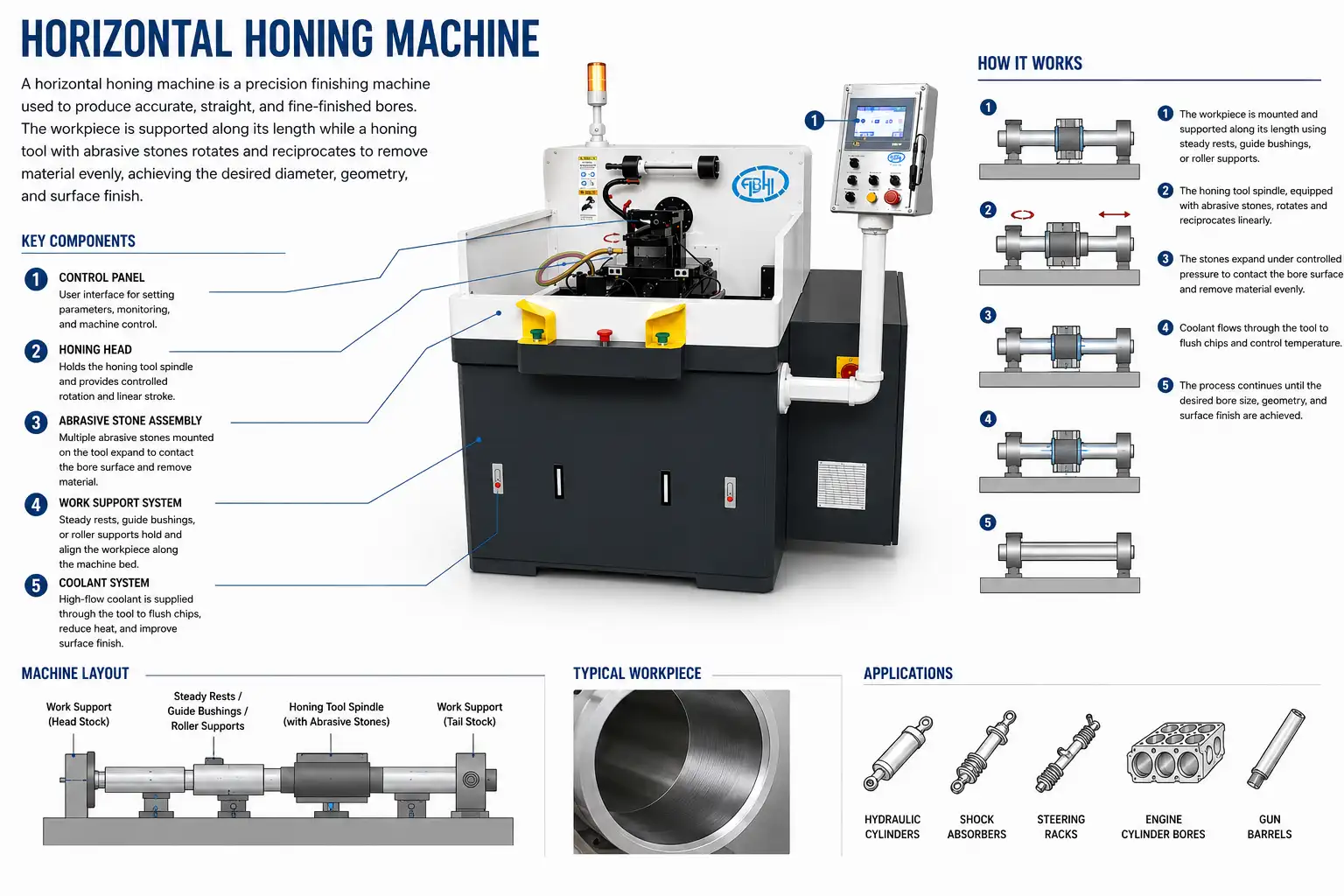
A horizontal honing machine is a precision finishing machine in which the workpiece and/or the honing tool spindle is oriented along a horizontal axis. The part is supported along its length by steady rests, guide bushings, or roller supports positioned along the machine bed, rather than being held only at a single top or bottom point. This orientation is also referred to as a horizontal hone, and in production lines where parts pass through the machine along one continuous axis, it may be described as an in-line honing machine. The purpose of the machine is to bring a bore to a final, precise diameter, roundness, straightness, and surface texture using rotating abrasive stones under controlled pressure and stroke motion.
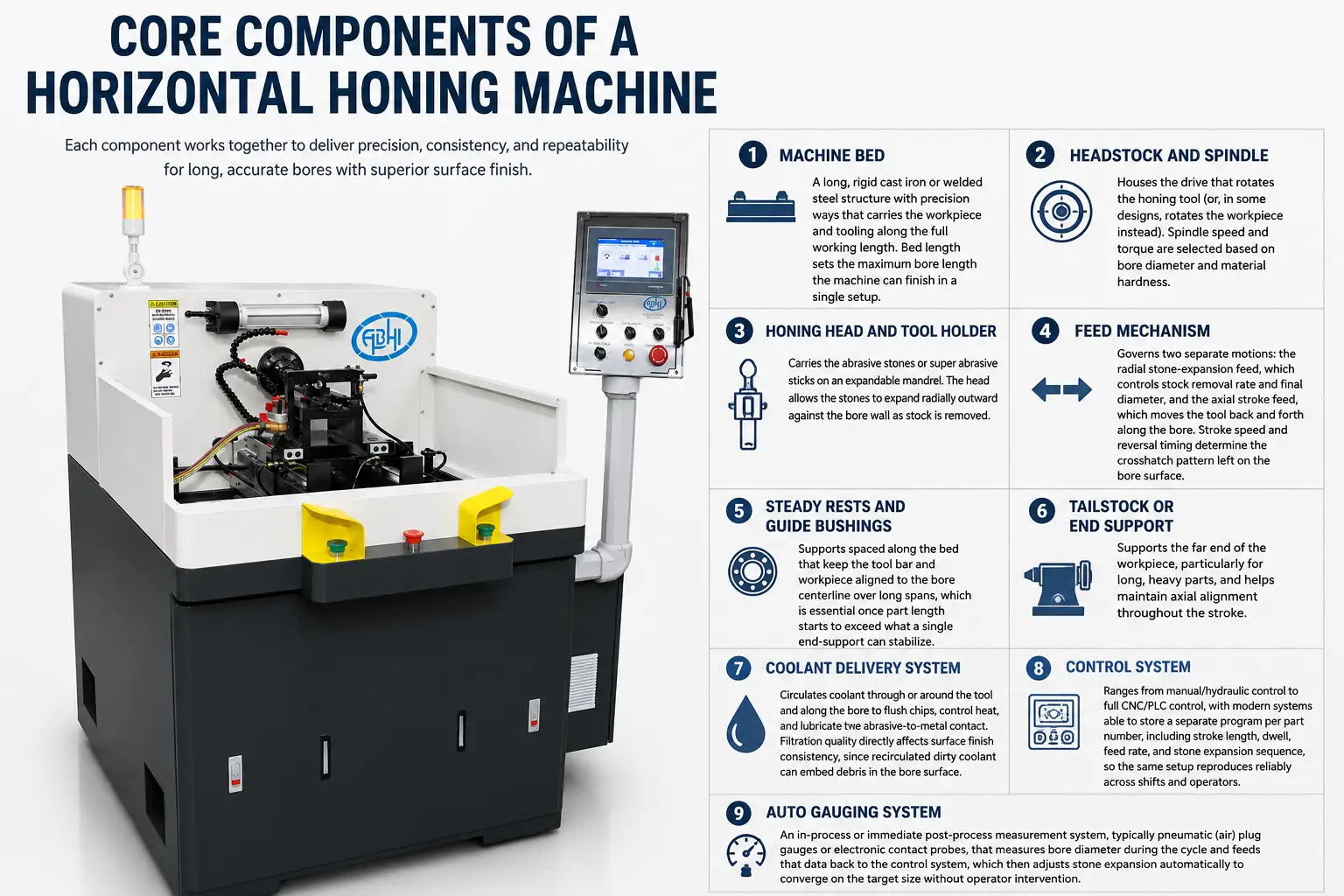
Core Components of a Horizontal Honing Machine
- Machine bed. A long, rigid cast iron or welded steel structure with precision ways that carries the workpiece and tooling along the full working length. Bed length sets the maximum bore length the machine can finish in a single setup.
- Headstock and spindle. Houses the drive that rotates the honing tool (or, in some designs, rotates the workpiece instead). Spindle speed and torque are selected based on bore diameter and material hardness.
- Honing head and tool holder. Carries the abrasive stones or super abrasive sticks on an expandable mandrel. The head allows the stones to expand radially outward against the bore wall as stock is removed.
- Feed mechanism. Governs two separate motions: the radial stone-expansion feed, which controls stock removal rate and final diameter, and the axial stroke feed, which moves the tool back and forth along the bore. Stroke speed and reversal timing determine the crosshatch pattern left on the bore surface.
- Steady rests and guide bushings. Supports spaced along the bed that keep the tool bar and workpiece aligned to the bore centerline over long spans, which is essential once part length starts to exceed what a single end-support can stabilize.
- Tailstock or end support. Supports the far end of the workpiece, particularly for long, heavy parts, and helps maintain axial alignment throughout the stroke.
- Coolant delivery system. Circulates coolant through or around the tool and along the bore to flush chips, control heat, and lubricate the abrasive-to-metal contact. Filtration quality directly affects surface finish consistency, since recirculated dirty coolant can embed debris in the bore surface.
- Control system. Ranges from manual/hydraulic control to full CNC/PLC control, with modern systems able to store a separate program per part number, including stroke length, dwell, feed rate, and stone expansion sequence, so the same setup reproduces reliably across shifts and operators.
- Auto gauging system. An in-process or immediate post-process measurement system, typically pneumatic (air) plug gauges or electronic contact probes, that measures bore diameter during the cycle and feeds that data back to the control system, which then adjusts stone expansion automatically to converge on the target size without operator intervention. This is one of the biggest contributors to reducing scrap and rework on long, expensive parts, since it catches drift before a part is finished out of tolerance.
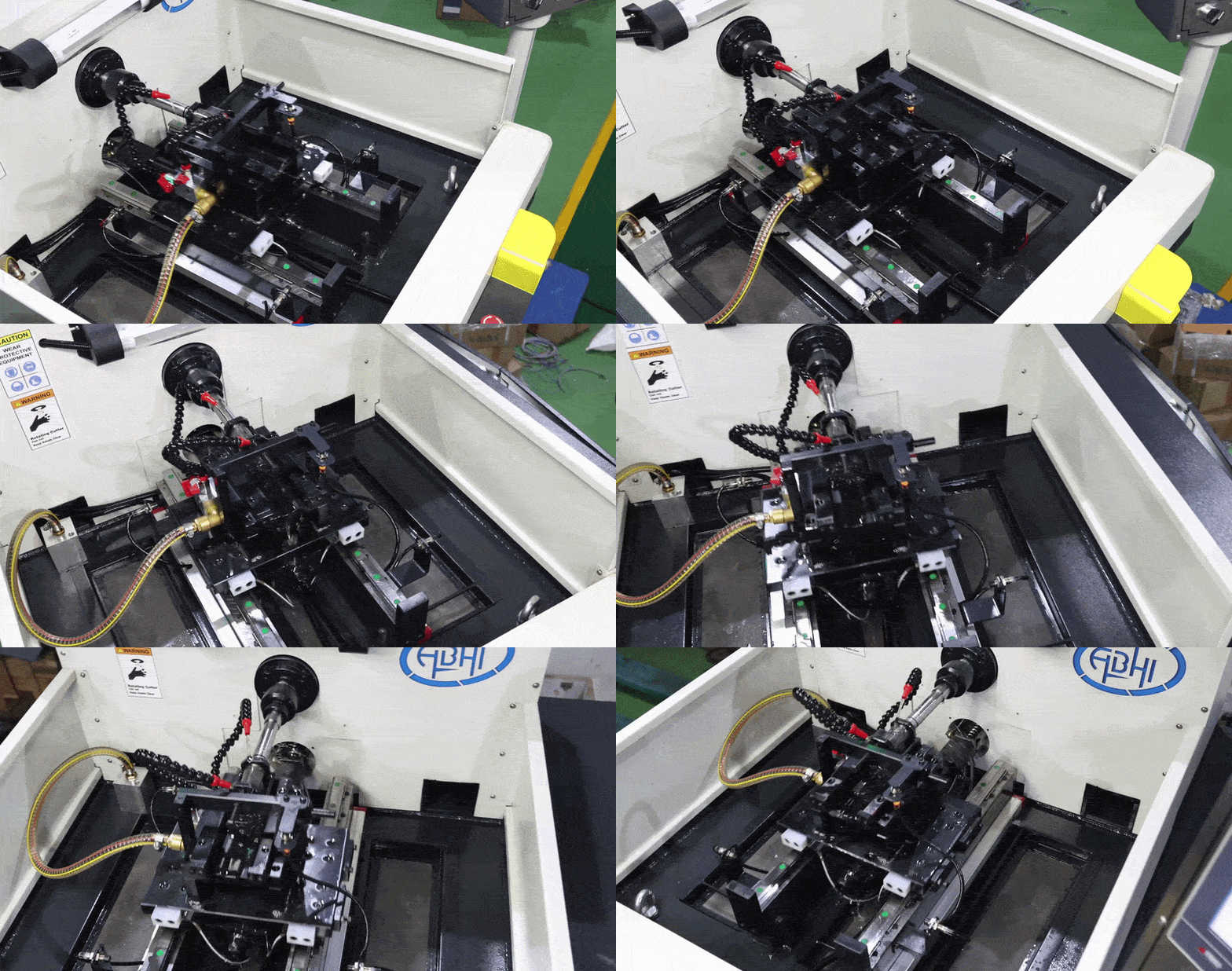
How the Horizontal Honing Cycle Works
- Load and align: The workpiece is loaded onto the bed and secured, with steady rests or guide bushings positioned along its length to support the bore axis.
- Tool insertion: The honing tool enters the bore, either by advancing the tool into a stationary part or advancing the part onto a stationary tool.
- Stone expansion: The abrasive stones expand radially to make initial contact with the bore wall at a controlled pressure.
- Stroking: The tool rotates while moving axially back and forth, generating the crosshatch pattern needed for lubricant retention in applications such as cylinder bores.
- Progressive expansion: Stone pressure is increased in stages: roughing, semi-finishing, and finishing, often switching abrasive grit between stages.
- Plateau honing: (where required). A final, light-pressure pass removes the sharp peaks left by finishing stones without disturbing the deeper valleys, producing a surface that retains oil in the valleys while presenting a smooth, low-friction bearing surface at the peaks.
- Gauging and correction: Bore diameter is checked by the auto gauging system, and expansion is adjusted in real time to converge on the target tolerance.
- Retraction and unload: Stones retract, the tool withdraws, and the finished part is unloaded and inspected.
Tooling and Abrasives Used
Abrasive and tooling choice is driven largely by the workpiece material, and this is one of the most important decisions in the process. Cast iron and mild steel are typically finished with conventional aluminium oxide or silicon carbide stones. Hardened steels, stainless steels, and other difficult-to-machine alloys usually call for super abrasives such as diamond or CBN to maintain stone life and consistent cutting performance. Softer or more heat-sensitive materials, such as aluminium or certain bronzes, often need lower cutting pressure and different coolant strategies to avoid loading the stone or generating excess heat. Getting this match right affects stone life, cycle time, achievable surface finish, and how often tooling needs to be changed during a production run.
- Conventional abrasive stones (aluminium oxide, silicon carbide). Used for general-purpose stock removal and finishing on cast iron and mild steel.
- Super abrasives (diamond, cubic boron nitride/CBN). Used for hardened steels and high-volume production, where stone life and dimensional consistency over long runs justify the higher tooling cost.
- Honing mandrels and tool bars. Sized to bore diameter and length; longer bores generally need tool bars with additional guide/support points to resist bending under cutting load.
- Bore gauges. Pneumatic (air) plug gauges or electronic bore gauges used to verify diameter, roundness, and straightness, often integrated directly into the auto gauging loop rather than used only for final offline inspection.
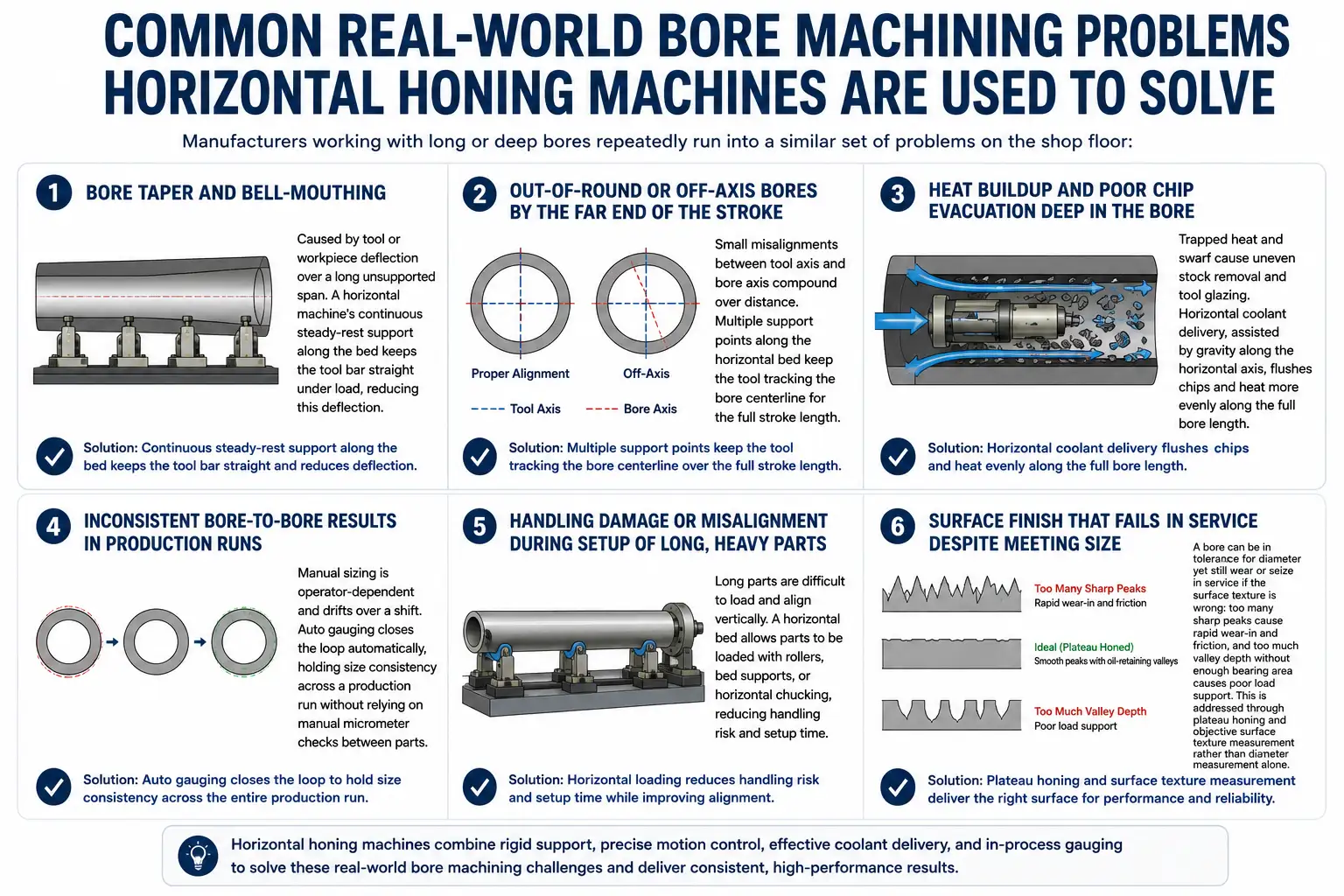
Common Real-World Bore Machining Problems Horizontal Honing Machines Are Used to Solve
Manufacturers working with long or deep bores repeatedly run into a similar set of problems on the shop floor:
- Bore taper and bell-mouthing. Caused by tool or workpiece deflection over a long unsupported span. A horizontal machine's continuous steady-rest support along the bed keeps the tool bar straight under load, reducing this deflection.
- Out-of-round or off-axis bores by the far end of the stroke. Small misalignments between tool axis and bore axis compound over distance. Multiple support points along the horizontal bed keep the tool tracking the bore centerline for the full stroke length.
- Heat buildup and poor chip evacuation deep in the bore. Trapped heat and swarf cause uneven stock removal and tool glazing. Horizontal coolant delivery, assisted by gravity along the horizontal axis, flushes chips and heat more evenly along the full bore length.
- Inconsistent bore-to-bore results in production runs. Manual sizing is operator-dependent and drifts over a shift. Auto gauging closes the loop automatically, holding size consistency across a production run without relying on manual micrometer checks between parts.
- Handling damage or misalignment during setup of long, heavy parts. Long parts are difficult to load and align vertically. A horizontal bed allows parts to be loaded with rollers, bed supports, or horizontal chucking, reducing handling risk and setup time.
- Surface finish that fails in service despite meeting size. A bore can be in tolerance for diameter yet still wear or seize in service if the surface texture is wrong: too many sharp peaks cause rapid wear-in and friction, and too much valley depth without enough bearing area causes poor load support. This is addressed through plateau honing and objective surface texture measurement rather than diameter measurement alone.
What Is the Abbott-Firestone Curve, and Why Does It Matter for Honing?
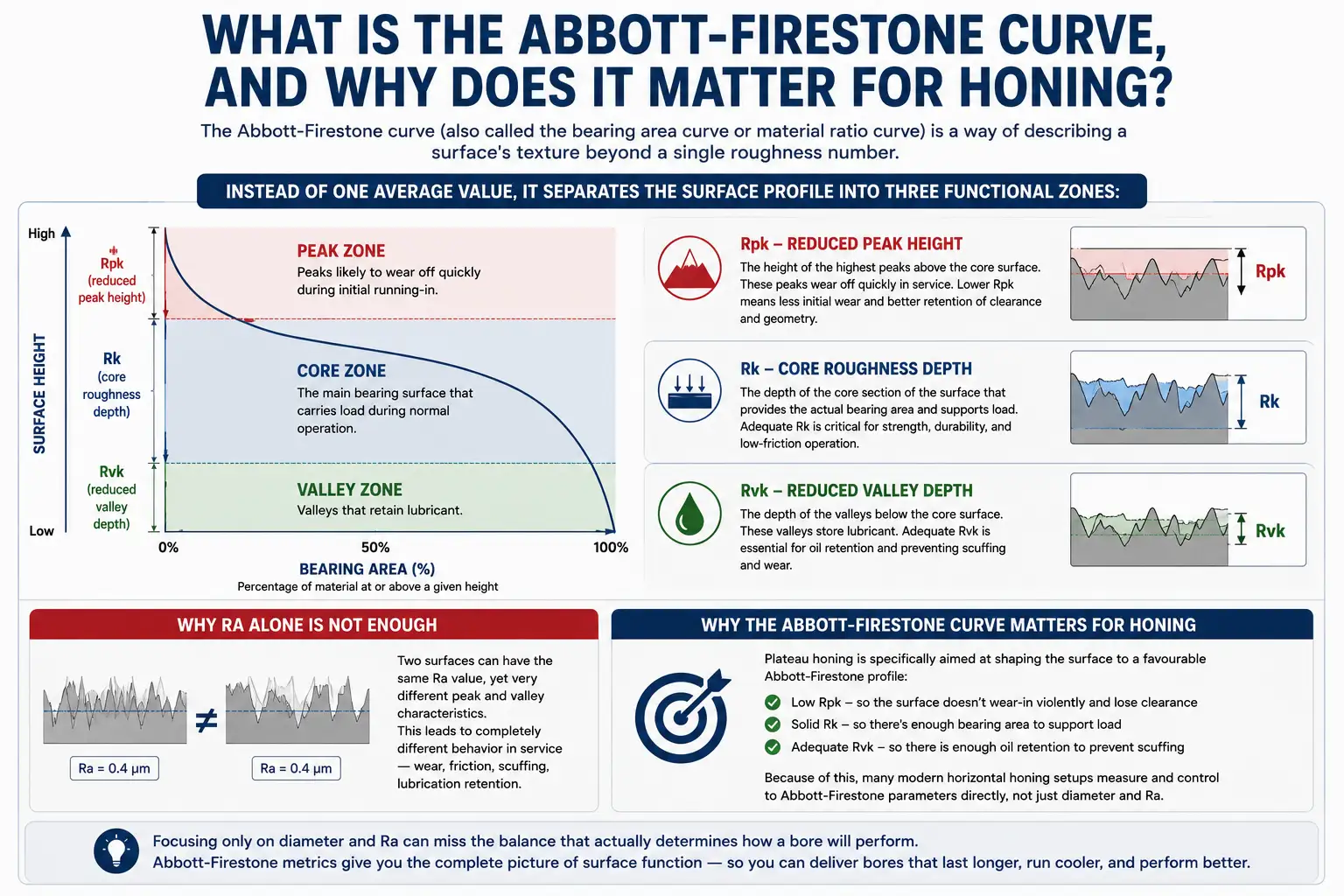
The Abbott-Firestone curve (also called the bearing area curve or material ratio curve) is a way of describing a surface's texture beyond a single roughness number. Instead of one average value, it separates the surface profile into three functional zones:
- Rpk (reduced peak height): the height of peaks likely to wear off quickly during initial running-in.
- Rk (core roughness depth): the main bearing surface that carries load during normal operation.
- RVk (reduced valley depth): the depth of valleys that retain lubricant
- Seal wear and premature leakage caused by incorrect surface texture (too rough or too smooth) inside the cylinder tube.
- Rod/piston stick-slip caused by inconsistent roundness or straightness along a long tube.
- Long production runs of cylinder tubes in varying lengths and diameters across a single product line.
- Plateau honing tuned to Abbott-Firestone parameters balances oil film retention against seal wear, extending seal life.
- Continuous bed support keeps straightness consistent along tubes that can run several meters long.
- Customizable tooling and adjustable bed/steady-rest configurations accommodate different tube lengths and diameters without a dedicated machine per part size.
- Oil consumption and blow-by caused by cylinder surface texture that doesn't retain enough lubricant
- Scoring or scuffing from finishing passes that leave sharp peaks.
- Cylinder-to-cylinder variation within the same engine block or between engines on a production line
- Multi-stage plateau honing produces the peak/core/valley balance engines need for controlled oil retention and reduced friction.
- Auto gauging holds bore size consistent cylinder to cylinder without relying on manual checks between parts.
- CNC/PLC-stored recipes reproduce the same crosshatch angle and finish parameters across an entire production run.
- Straightness and roundness requirements often measured in single-digit microns over long lengths.
- Hard, difficult-to-machine materials (high-strength steels, titanium alloys) that wear conventional abrasives quickly.
- Zero tolerance for subsurface thermal damage that could affect fatigue life.
- Super abrasive tooling (CBN, diamond) maintains cutting consistency on hardened materials over long production runs.
- Continuous support along the bed and precise feed control help hold tight straightness over long stroke lengths.
- Controlled, moderate cutting pressures with effective coolant flow limit heat generation that could otherwise alter the material's metallurgical properties near the surface.
- Large, heavy, long parts that are difficult and risky to handle in vertical orientations.
- Need for interchangeable parts across a fleet of equipment, requiring tight dimensional repeatability.
- Harsh operating environments that demand a wear-resistant, well-controlled bore surface.
- Horizontal beds with rollers or bed supports simplify loading and reduce handling risk for long, heavy components.
- Auto gauging and CNC/PLC-controlled cycles produce repeatable dimensions across batches, supporting part interchangeability.
- Abrasive selection and multi-stage finishing can be tuned to the wear and corrosion demands of downhole environments.
- Very large, low-volume, high-value parts where a scrapped bore is extremely costly.
- Long lead times if a part has to be reworked or remade.
- Wide variation in part size from job to job, sometimes within the same shop.
- Auto gauging catches dimensional drift mid-cycle, reducing the risk of scrapping an expensive, hard-to-replace part.
- Customizable tooling and adjustable steady-rest spacing let one machine cover a wide range of bore diameters and lengths.
- Long-bed capacity accommodates the scale of marine engine liners or large press cylinders that would exceed shorter machine platforms.
- Bore straightness directly affecting shot accuracy and consistency.
- Surface finish affecting fouling buildup and corrosion resistance over the service life of the barrel.
- Tight, repeatable tolerances required across high production volumes.
- Continuous bed support helps maintain straightness over the full barrel length.
- Super abrasive finishing and controlled plateau honing manage surface texture for reduced fouling and corrosion resistance.
- Auto gauging supports tight tolerance repeatability across large production batches.
- Customizable configurations. Adjustable bed length, modular tooling, and repositionable steady rests let a single machine platform cover multiple part families rather than requiring dedicated equipment per part size.
- Auto gauging with closed-loop correction. Real-time diameter feedback lets the control system correct stone expansion mid-cycle, reducing scrap and operator dependency, especially valuable on large or costly parts where a single bad bore is expensive to lose.
- Abbott-Firestone/plateau honing control. Controlling to Rpk/Rk/Rvk parameters, not just Ra and diameter, produces a surface engineered for how the part actually performs in service, including oil retention, wear-in behaviour, and load-bearing capacity, which is especially relevant for cylinders, engine liners, and any sliding or reciprocating fit.
- Quick-change tooling and fixturing. Modular tool bars and fixture elements reduce changeover time between part numbers, which matters in job shops or mixed-production environments handling multiple sectors.
- Tool and stone wear monitoring. Some systems track stone wear or cutting force trends over a production run and flag when a stone change is needed, helping maintain consistent finish quality without relying purely on a fixed change interval.
- Statistical process control (SPC) integration. Auto gauging data can be logged and fed into SPC systems, giving manufacturers a continuous quality record per part, which supports traceability requirements common in aerospace, defence, and automotive supply chains.
- Compatibility with automated load/unload. Horizontal bed layouts are generally straightforward to integrate with robotic or conveyor-based load/unload systems, supporting higher-volume production without proportionally increasing labour.
Plateau honing is specifically aimed at shaping the surface to a favourable Abbott-Firestone profile: a low Rpk (so the surface doesn't wear-in violently and lose clearance), a solid Rk (so there's enough bearing area to support load), and an adequate Rvk (so there is enough oil retention to prevent scuffing). Bore honing that only targets a diameter, and an average roughness (Ra) can miss this balance entirely: two bores can have an identical Ra value and behave completely differently in service depending on their Rpk/Rk/Rvk distribution. Because of this, many modern horizontal honing setups measure and control to Abbott-Firestone parameters directly, not just diameter and Ra.
Sector-Wise Applications: Issues Manufacturers Face and How Horizontal Honing Machines Help
Hydraulic and Pneumatic Cylinders
Issues manufacturers report:
How horizontal honing machines help:
Automotive and Diesel Engine Manufacturing (Cylinder Liners)
Issues manufacturers report:
How horizontal honing machines help:
Aerospace and Defence (Actuators, Landing Gear Struts, Gun Barrels)
Issues manufacturers report:
How horizontal honing machines help:
Oil and Gas Equipment (Drill Collars, Downhole Tools, Valve Bodies)
Issues manufacturers report:
How horizontal honing machines help:
Heavy Industrial, Marine, and Power Generation (Large Engine Liners, Hydraulic Press Cylinders)
Issues manufacturers report:
How horizontal honing machines help:
Firearms Manufacturing (Barrels)
Issues manufacturers report:
How horizontal honing machines help:
What Makes Horizontal Honing Machines Well-Suited to These Sectors
Typical Specification Ranges
| Specification | Typical Range (Varies by Manufacturer/Model) |
| Bore Diameter Capacity | Roughly 5 mm to 500+ mm depending on machine size |
| Stroke/Bore Length Capacity | From under 1 m up to several meters on long-bed machines |
| Achievable Roundness/Straightness | Single-digit microns to a few tens of microns on well-controlled setups |
| Surface Finish (Ra) | Sub-micron to a few microns depending on abrasive and process stage |
| Control Type | Manual/hydraulic, semi-automatic, or full CNC/PLC |
Note: These ranges are general and vary significantly by machine manufacturer, model, and configuration. Actual capability for a given application should be confirmed against a specific machine's published specifications.
Frequently Asked Questions (FAQ)
What is the difference between honing and boring?
Boring removes bulk material to bring a bore close to final size, while honing is a finishing process that uses abrasive stones to achieve final diameter, roundness, straightness, and surface finish specifications.
What is plateau honing?
Plateau honing is a two-stage (or multi-stage) honing process where an initial finishing pass creates the surface texture, followed by a light final pass that removes sharp surface peaks without disturbing the deeper valleys, producing a surface with good load-bearing area and retained lubrication.
What is auto gauging in honing?
Auto gauging refers to in-process or immediate post-process automatic measurement of bore diameter, fed back to the machine's control system so it can adjust abrasive stone expansion in real time to hold size without manual operator checks.
What is the Abbott-Firestone curve used for in honing?
It is used to characterize surface texture in more functional detail than a single roughness value, breaking the profile into peak (Rpk), core (Rk), and valley (Rvk) zones so the honing process can be tuned for how the surface will actually perform in service, such as oil retention and wear-in behavior.
What length-to-diameter ratio is considered a "long bore"?
There is no single universal cutoff, but ratios above roughly 10:1 are commonly treated as long bores requiring specialized tooling, support, and process control.
What industries commonly use horizontal honing machines?
Hydraulics and pneumatics, automotive and diesel engine manufacturing, aerospace and defense, oil and gas equipment, heavy industrial and marine, and firearms manufacturing are common users of horizontal honing processes.
Recent Posts
Tell us how can we assist you?
We are always happy to answer any questions!
Just fill in the form and we will get back to you.
© 2026 Abhi Fine Products. All rights reserved.
Designed & Developed by Appac Mediatech Pvt Ltd